
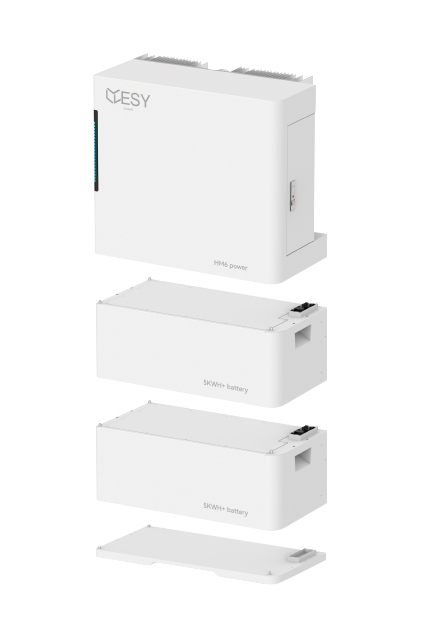
Residential ESS, commercial storage and bidirectional charging serve different energy needs. Homes usually choose 5–30 kWh ESS for solar self-use and backup, commercial buildings select 100 kWh to multi-MWh systems for demand management, while bidirectional charging uses 40–100 kWh EV batteries for flexible energy supply. The right option depends on electricity usage, solar generation, tariff structure and required backup duration.
Residential ESS is designed for households that want to store solar energy and use it when electricity demand is higher. A typical residential system combines rooftop PV, a battery pack, an inverter and an energy management system.
In 2025, residential battery systems in many markets commonly ranged from 5 kWh to 20 kWh, while larger homes often installed 30 kWh or more. A household with a 10 kW solar system may produce 35–60 kWh of electricity on a clear day, but without storage, only around 30–40% may be consumed directly onsite.
Adding an ESS allows more solar power to be stored during daytime and used during evening hours when household consumption increases. In regions with time-of-use electricity pricing, this can reduce electricity purchases during expensive periods.
A 10 kWh battery with 90% usable depth of discharge and 92% round-trip efficiency provides about 8.3 kWh of practical daily energy delivery.
The design of residential ESS depends on both energy capacity and output power. Battery size determines how long loads can operate, while inverter power determines which appliances can run at the same time.
For example, a 5 kW inverter can support common household equipment such as lighting, refrigerators, internet devices and small appliances. Larger loads including air conditioners, heat pumps and electric water heaters may require 8–15 kW inverter capacity.
Battery chemistry also affects system selection. Lithium iron phosphate (LFP) batteries have become common in residential applications because many models support more than 6,000 charge cycles at 80% capacity retention. Compared with earlier lithium nickel manganese cobalt oxide (NMC) batteries, LFP systems generally provide better thermal stability for stationary applications.
The next consideration is backup operation. Residential ESS systems are often installed in areas where grid interruptions occur several times per year.
A backup-focused installation normally separates critical loads from non-essential loads. Critical circuits may include refrigerators, lighting, communication equipment and medical devices, while high-power equipment may remain disconnected during outages.
A 15 kWh battery can provide approximately:
| Household Load | Average Power | Approximate Operating Time |
|---|---|---|
| Refrigerator + lights + Wi-Fi | 300–600 W | 20–40 hours |
| Small office equipment | 800–1200 W | 10–18 hours |
| Air conditioner | 2–4 kW | 3–6 hours |
The growing use of rooftop solar has also changed how homeowners view energy storage. In markets such as Germany, Australia and the United States, solar export prices are often lower than retail electricity prices, making self-consumption more attractive.
Commercial storage follows a different approach because commercial electricity use is usually larger and more variable. Office buildings, factories and warehouses may have peak demand periods that strongly influence monthly electricity costs.
A commercial battery system can reduce grid demand during short high-consumption periods. For example, a facility with a 2 MW peak demand may install a 1 MW/2 MWh battery system to reduce the amount of electricity purchased during peak tariff windows.
Commercial systems are commonly sized from 100 kWh to several megawatt-hours. According to market deployments in 2024, many medium-sized commercial projects used 500 kWh–2 MWh battery cabinets, while large industrial sites installed systems above 10 MWh.
The operating strategy is different from residential storage. Instead of only storing solar energy, commercial systems may perform several functions:
| Application | Typical Purpose |
|---|---|
| Peak shaving | Reduce maximum grid demand |
| Solar shifting | Move excess PV generation to later hours |
| Backup supply | Maintain selected business operations |
| Grid services | Support frequency and voltage regulation |
Commercial storage projects require more advanced control systems because electricity consumption changes throughout the day. Manufacturing equipment, HVAC systems and production schedules can create rapid changes in power demand.
For example, a warehouse operating refrigeration equipment may have a stable 24-hour electricity profile, while a manufacturing facility may experience short peaks caused by production lines starting simultaneously.
Battery lifetime planning is also important for commercial installations. A system cycling once per day may complete around 365 cycles annually. After 10 years, this represents more than 3,600 operating cycles, making thermal control, battery management software and maintenance planning important parts of system design.
Bidirectional charging introduces another option by using EV batteries as energy storage resources. Traditional charging only transfers electricity from the grid to the vehicle, while bidirectional charging allows electricity to move in both directions.
Vehicle-to-home (V2H) systems allow an EV to supply household electricity during outages or high-price periods. Vehicle-to-grid (V2G) systems allow connected vehicles to support grid operation when electricity demand changes.
A modern electric vehicle often contains a 60–100 kWh battery pack. A 75 kWh EV battery can theoretically supply a home using 15 kWh per day for approximately five days, although actual operation depends on battery limits, conversion efficiency and vehicle availability.
Bidirectional charging turns an EV from only a transportation device into an additional energy resource connected to the home or grid.
However, bidirectional charging requires compatible vehicles, chargers and communication standards. The charging equipment must support power flow control, safety monitoring and grid connection requirements.
The adoption of bidirectional charging has increased as automakers introduced compatible platforms. Standards such as ISO 15118 are being developed to improve communication between vehicles, chargers and energy systems.
For users who already own an EV, bidirectional charging may reduce the need for a separate stationary battery. For households without EV ownership, a dedicated residential ESS remains a more predictable solution because the battery stays installed at the property.
Some manufacturers are combining these functions through all-in-one ESS and bidirectional EV charging products that integrate battery storage, solar connection and EV energy exchange in one system.
The choice between these three technologies can be compared through several practical factors:
| Factor | Residential ESS | Commercial Storage | Bidirectional Charging |
|---|---|---|---|
| Typical Capacity | 5–30 kWh | 100 kWh–MWh | 40–100 kWh |
| Main User | Homeowners | Businesses | EV owners and fleets |
| Installation Location | Home | Commercial site | Home or charging location |
| Main Function | Solar use and backup | Electricity cost management | Vehicle energy sharing |
| Availability | Always onsite | Always onsite | Depends on vehicle connection |
System economics depend on electricity prices, solar output and equipment costs. A residential battery may have a longer payback period in areas with low electricity prices, while regions with high retail rates can achieve better financial performance.
Commercial storage economics are usually influenced by demand charges. In some electricity markets, demand-related fees can represent 30–50% of a commercial electricity bill, making battery-based peak reduction more attractive.
Bidirectional charging economics depend on vehicle ownership patterns. If an EV is parked at home for most of the day and charging infrastructure supports two-way operation, the battery can provide additional energy flexibility.
Future energy systems will likely combine different technologies rather than relying on one solution. A household may use rooftop solar, a stationary ESS and an EV charger together. A commercial building may operate solar panels, battery storage and workplace EV charging under one energy management platform.
Artificial intelligence-based forecasting, smart meters and automated energy controls are expected to improve system operation. In 2024, many energy management platforms already used weather forecasts, electricity prices and historical consumption data to adjust charging schedules.
Selecting residential ESS, commercial storage or bidirectional charging requires matching system design with actual electricity use. Battery capacity, inverter power, charging behavior and future energy needs should all be considered before installation.